Sunday, October 16, 2016

SWF 2016 - interview with Chihoi


I can’t remember when I first came across Chihoi’s work but I do remember being blown away by it. One does not so much ‘read’ Chihoi’s comics but one encounters and experiences it in a visceral manner, especially seeing his originals at an exhibition at the Hong Kong Art Centre many years ago.

To me, he is like the third generation of alternative comic artists in HK (he would elaborate on that point in the answers below). But what really differentiates him is the experimental nature of his work, in his play with the form and substance of the comic medium.

I am tempted to say this makes his work closer to literature, but that would privilege the literariness of comics over its other aspects. To me, comics is more than that and it can be anything if we keep pushing the medium. Chihoi is one of these people pushing the frontier of what comics can do. And when I thought about inviting a comic artist from Asia for this year’s SWF, his name comes to mind.


From SWF website:

Chihoi was born in Hong Kong in 1977. He has loved drawing since childhood and started to publish comics and illustrations when he was bored by his food and nutritional studies in university. His comics have appeared in Hong Kong newspapers and international anthologies. Major publications include the collaborative projects Hijacking - Comic Hong Kong Literature, The Train and a solo work, Still Life. His comics have been translated into Italian, French, English and Finnish. His website is www.chihoi.net

Here’s a short interview with him via email ahead of his visit:

Are you doing comics or are you doing art?

Both. There're stories in my mind that I wanna draw in the form of comics. And there're images in my mind that I wanna express as a piece of artwork which I cannot express otherwise.

You didn't grow up reading comics. Is that a good or bad thing for your work?

Good in a way that I didn't have any presumption of what a comic book should look like. I just had something in my mind and tried to find my way to tell it.

In my secondary school days, I used to do some pastel drawings as a hobby. It's like a diary or dialogue to myself. I enjoyed the private time of making art without thinking of publishing them. This private time is important to any artist.

I had not discovered the form of comics until later in university time when I discovered Lai Tat Tat Wing's experimental works.

I see a linage of independent /alternative comic artists from Li Chi Tak to Lai Tat Tat Wing to you. Would this be accurate?

You can say so. Li Chi Tak had been a famous icon from 80s to mid-90s. Lai Tat Tat Wing had known Li's works for a long time until he started to publish comics in mid-90s. For my case, I started around 1996-97, soon after Lai's publications. Sometimes Lai says to me like, "We're actually the same generation, right? I'm not that old!" Haha!

Your preference is for the use of pencil to create very dense and heavy shading. Why did you choose this particular style / way of working?

On one hand I got inspired by some European comics artists like Anke Feuchtenberger, Amanda Vahamaki, etc., their works of pencil and charcoal are just amazing.

On the other hand, in our book Hijacking - Comic Hong Kong Literature that I collaborated with Kongkee, we have tried many different techniques and media to adapt various writers' works. Pencil by then has become my favourite tool. The force and emotion from my heart extend directly to the hand and to the pencil. The smudges create sense of depth, and some kind of melancholic atmosphere that ink cannot do.


I visited Helsinki and Stockholm recently and saw that you were there too for their comic festivals. Do the audience in Europe read your comics differently from the readers in HK?

I guess much the same. In both HK and Europe, they publish my books normally in small print run, like 500 to 1000, sometimes 2000. I guess I'm only known to small circle of people.

But in Europe there're more small publishers who have the sensitivity and guts to discover good artists and publish more edgy works.

In HK, the main problem is the expensive rent that makes small publishers and small bookshops difficult to survive.

How did Fa Fa World come about? I see traces of Lo Koon Chiu's 小圓圓 and also EO Plauen's Father and Son... did you read these comic strips?

When I was little, I didn't read much of Lo Koon Chiu's works except when I visited Grandpa. In Grandpa's place I used to read Wong Sze Ma's 牛仔. In 2008 when the newspaper asked me to do a column, I was re-reading a bunch of 牛仔 and discovered a long lost world. So I created Fa Fa World, and drew simple daily life stories between a father and a daughter.


What is the future for HK comics?

I hope there're more editors to do some archival publications, like re-edition of old comics from 1950s-70s. Or someone who can re-edit those comic columns scattered around so many newspapers of the time.

What is the future for HK?

I'm quite pessimistic, in a way that I'm afraid I'll be blamed for being pessimistic.

Can one still be an independent and alternative artist in HK?

Yes of course, among different arts, comics is the cheapest way to begin.


You can find details of Chihoi’s panels at SWF here:

https://www.singaporewritersfestival.com/nacswf/nacswf/author-speaker/Chihoi----.html

Saturday, October 15, 2016

Illustration Arts Fest 2016 - Interview with Isabel Greenberg


OIC is organizing the inaugural Illustration Arts Fest at LaSalle College of the Arts at the end of this month and one of the guests they have invited is the talented Isabel Greenberg. She is one of the most refreshing young comic creators to come out of the UK. Recently she spoke about the future of the graphic novel at the London Literature Festival at the Southbank Centre, London.

From her website:

Isabel Greenberg is a London based illustrator and writer. Her first graphic novel 'The Encyclopedia of Early Earth' was publushed in 2013 by Jonathan Cape in the UK, Random House in Canada and Little Brown in the US. It has since been translated into French, Spanish, Korean and Chinese.

It was nominated for two Eisner awards, won the Best Book catagory at the British comic awards, was one of NPR's 100 books of the year, was the Guradian's graphic novel pick of the month and was in the New York Times Graphic Books best seller list.

She studied illustration at the University of Brighton and since graduating has worked for a variety of clients including The Guardian, Nobrow Press, The National Trust, Seven Stories Press, Solipsistic Pop, First Second and The New York Times. In 2011 she won the Observer Jonathan Cape Graphic short story prize. She exhibited work in the Memory Palace exhibition at the V&A, and was a select at Pick Me Up 2014 at Somerset House.


Her second graphic novel, The One Hundred Nights of Hero, will be on sale at the Illustration Arts Fest.

Ahead of her visit, here’s a short interview with her conducted over email.


You entered The Observer / Cape / Comica Graphic Short Story Prize in 2009 and came in 2nd. You entered it again in 2011 and won, which led to the book deal. The Encyclopedia of Early Earth came out in 2013. How have your work and your life changed since then with all the attention and critical acclaim?

Well I get a lot more work which is very nice, and have more freedom to do the projects I like. At the time of making my first book, I had a part time job as a nanny, and after the book I was able to get enough work (and teach as well) so that I no longer had to. That’s the main way it has changed.

In 2014, I saw you many times at the various cons and small press events and I really admire your work ethics. Are you doing comics full time now?

Up until this year I was full time, doing graphic novels, some illustration commissions like children books and also teaching. But this year I have actually gone back to school, and am doing a masters in Animation!


Who are some of your influences? Tove Jansson? Ursula K. Le Guin?

Yes! I love both! Other artists and writers I like include Phillip Pullman, Leanne Sharpton, Russel Hoban, Alexis Deacon, David B, Marjane Satrapi and so many others!

How much preparation do you do for your world building? Do you have stacks and stacks of notes?

Yes, I write lots of stories. Some of them never make it into the final books, but it helps to make the world richer.

Tell us about the new book, The One Hundred Nights of Hero.

The One Hundred Nights of Hero is set in the same world as my first book, but is not a direct follow on. It is set around two main characters; Hero and Cherry, who are forced to tell a series of stories in order to save their lives. It’s a bit of an ode to the Scheherazade.


What do you look forward to in Singapore? What kind of food is on your must-eat list?

I don’t know what food is best to eat, I am hoping I will get to try lots of new things! I am not a fussy eater, so I like trying new things. I am also excited to see the Botanical Gardens.


Details of the Illustration Arts Fest and Isabel’s events are here:

http://illustrationartsfest.org

Friday, October 14, 2016

SWF 2016 - Interview with Peter van Dongen


I first heard about Peter van Dongen’s Rampokan from my friend, Tita Larasati many years ago. A story set in Indonesia in 1946 and spanned the islands of Java and Celebes, with the background of the Dutch police action as its setting. Other than the political intrigue, double-crossing and betrayal (and a huge cast of characters), it is a story of a sentimental young man trying to look for the Indonesia of his past and making fatal mistakes in the process of doing that. In a way, the protagonist, Johan Knevel, represents the old Dutch who still thinks the Indies will welcome them back with open arms. He is trapped in the past and there will be hell to pay for those who cannot live in the present and see the future for what it is.

Book One Java was published in 1999 and Book Two Celebes was published in 2004. In 2014, the books were compiled as one volume and published in Bahasa Indonesia by Gramedia. A year later, Gramedia released the English edition. With the Bahasa and English editions out, I knew I had to invite Peter for the Singapore Writers Fest this year as I felt we do not know enough of our region’s history, especially our immediate neighbour, Indoneisa.

From the SWF bio:

Peter van Dongen is a Dutch comic artist and illustrator. His acclaimed graphic novels Rampokan Java (1998) and Rampokan Celebes (2004) are set in the time of the Revolution in Indonesia and were translated into French, German, Bahasa Indonesia and English. Co-designed by Joost Swarte, Rampokan Java was awarded the 1999 Dutch Prize for Best Book Design. Current projects by Van Dongen include a graphic novel adaptation of Familieziek (Repatriated) by Adriaan van Dis and a collaboration with Teun Berserik to illustrate a two-part adventure of Blake & Mortimer, a quintessentially British detective duo created by Edgar P Jacobs.


What sparked your interest in history, especially that period of Dutch police action? (1945 – 1949) What do you think of the term, 'police action'?

Of course the term 'police action' is only used for all these years to cover up the real story of what was really happening between 1946 and 1949: a colonial war, with probably more then 100.000 Indonesian casualties and 5000 for Holland. We thought for years that real Dutch people were not able to do such things as happens in a real war: killing so many people, the real dirty work as war always is.

So when you tell the Dutch people at home their boys were fighting only for the good cause as in the so-called ‘police action’, everybody wants to believe that. But nowadays, it's a common thought it wasn't like that, but it’s a real dirty war.

So my interest in this period of the Dutch Indies came from my mother who was born there at Sulawesi in 1941 and I realized I didn't knew anything about her land of birth. I never had a proper history lesson about this at all in school, so I decided to make a comic about her home country. Of course, we had heard everything about World War 2 in Europe/Holland, but hardly anything about Indonesia during that time and really nothing about this war of independence.

How many years of research did you put into Rampokan? How many trips did you make to the Dutch and Indonesian archives and visiting Indonesia itself?

Altogether 3.5 years before I finally started with the first page (19 in the English edition), but during my research I was working on the scenario as well. It was before google when I begun to find my way. I first went to the libraries where I found so many written books about it. Strange that in school it was hardly ever told, because everything was already there in the libraries.

In these 3.5 years I visited only once the Dutch archives (KIT, Royal Tropical Institute) and in 1992 some in Indonesia; it was my first trip then to this country. But to finish the project, it took me altogether 13 years, so during that time I visited Indonesia every 5 years and more Dutch archives too. It was and is still a learning curve.


Can you share with us about your own family background and experience and how they have shaped the creation of Rampokan?

My Mother is born in 1941 at Manado, Celebes/Sulawesi. Her father was a sergeant-major for the Dutch Indies Colonial Army (K.N.I.L.); an Indo, of mixed European/Indonesian. He, Henri Johan Kneefel, married in 1937 his mixed Chinese/Indonesian wife, Engelina Ong, on the island of Ternate, their place of birth. They had three daughters, including my mother, the middle one. During World War 2, my grand father was imprisoned by the Japanese for more then two years and finally beheaded on August 16th, one day after the capitulation of Japan.

My grand mother lost everything during the war, so she decided as a widow with three daughters to come over to the Netherlands after the independence of Indonesia. In fact, she was an immigrant trying to find for herself and for her daughters a better life, like so many of today’s immigrants in Europe. But it wasn't easy for her to come to Holland even though her husband lost his life for this land.

Europe is in flux now with Brexit, the immigrant issue, the Burkini controversy in France and the threat of terrorism. To me, your story about encountering different cultures, mixed marriages and parentage/ heritage is all the more relevant now. What are your views about the situation in Europe today?

What I can see as an average man who is reading his daily newspaper and watching the national news, it's all about fear. Fear to lose all the things people had gotten used to in the past 60 years. For instance, the fear of losing their jobs because of the migrants from Eastern Europe, The European Union had taken away their national identity, but above all, it is the fear of losing their national culture and tradition because of the migrants from the Middle East, such as their freedom of speech. Many times we hear on TV or the radio that the people are afraid of the ‘Sharia in Europe’.

15 years ago, the people had a lot more compassion for 'the others', people were able to share more. But since 9-11, everything has changed. During debates, there is hardly any room left for different shades of meaning. It is often one or the other. For instance, I am a product of an interracial marriage and sometimes when I hear people say that they only want a spouse from their 'own group', I feel kind of offended. What are they afraid of? To have a mixed child as I am?

I don't now how this will end: with the constant threat of terrorism nearby, the European crisis with the Southern and Northern parts, the war in Syria, the immigration…It's quite too much for an average man who is just following the daily regular news.


You have quite a big fan base in Indonesia. How have the readers there responded to Rampokan?

Good! Turns out I am telling a story here about their history they never really heard about. From a different perspective. Another thing I found out from talking with lots of Indonesians whom I met is that they love Tintin. My work is quite obvious influenced by Hergé, so Rampokan feels like Tintin in Indonesia. And in some reviews, it was questioned why there was no Indonesian comic artist who could make this book. Apparently, it had to be a foreigner (with Indonesian roots) who was able to do it. I took that as a compliment, haha.

This would be your second trip to Singapore. What are you looking forward to?

The food in Chinatown! I remember I had some delicious meals on the streets. And of course, to meet new people at the festival to hang out with.

Finally, tell us about your band in Holland.

My band, The Original Talkatives, was formed by my eldest brother Arnold (guitar) in 1980 for one gig only at the school party. We were just some kids from 13 (me on drums) to 15 years old from the same school, Montessori Lyceum Amsterdam. We did mostly cover songs from the Police. But because everybody was that impressed, we decided to continue.

Later on, my twin brother joined the band as well on keyboard and during the 6 years, we released 4 singles on vinyl, played everywhere in Holland in clubs, festivals, for radio and TV, and once in Berlin and Curaçoa. We played kind of pop ska/reggae, the music form that was really popular in those days from bands like Madness, The Specials and The English Beat.

So finally the band split up in 1986 after the release of our last single, High Pressure. Actually, we recorded another song for the single, called Squeeze Louise, but the first 10 seconds got lost and there was no time and money left to do it all over again.

For 27 years everybody went his own way, but three years ago I decided to release this song on vinyl, just for fun, and because of this we had the opportunity in 2015 to do a reunion gig to promote this at the festival Indomania in the Melkweg, Amsterdam. Yes, we reformed the original band together but just only for this event. But who knows for the future? We had so much fun playing together after 29 years!

My two brothers kept on going in the music field and played in the famous Dutch band Loïs Lane who was the support act for Prince during his European tour in 1990.

https://www.youtube.com/watch?v=GV38Hf77GME

https://www.youtube.com/watch?v=dOOpXHdZ84A


Ending the interview with Peter by asking him about his band is deliberate. When he gave me the Squeeze Louise 7” a few years ago, I was intrigued not so much that a comic artist was in a band (we have many examples of that), but that one can be of a mixed parentage like Peter with so much history in his blood, and can still be open and global in outlook – reading and creating clean lines style comics ala Herge and listening and playing in a Dutch ska band influenced by Madness.

That gives us hope and an indication of what the future can be. (Peter’s little boy is into drums at home) As much as we need to know the past, we should not be trapped by it.

https://www.youtube.com/watch?v=Vc3mm2aH2g8


You can find Peter’s panels at SWF here:

https://www.singaporewritersfestival.com/nacswf/nacswf/author-speaker/Peter-van-Dongen-.html

Tuesday, October 4, 2016

SWF 2016 - Interview with Miriam Katin


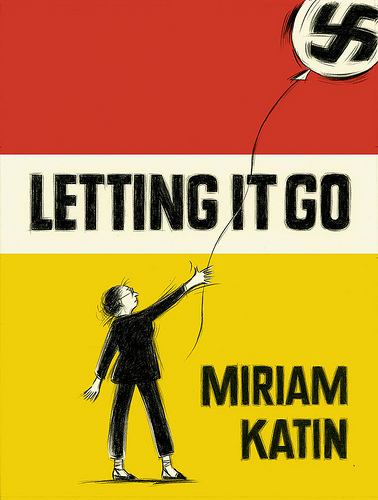
Miriam Katin is proof that it is never too late to do comics. Or to do anything at all. I first encountered her comics in the early 2000s in the Rosetta anthologies (Alternative Comics) and I couldn’t find much information about her. In 2006, she released We Are On Our Own, her graphic memoir about her mother’s escape from Nazi-occupied Hungary to much acclaim. A sequel of sorts, Letting It Go, was released in 2013.

Here’s the Drawn & Quarterly bio of her:

Miriam Katin was born in Hungary during World War II. She later immigrated to Israel and then the United States, where she worked in background design for animation studios such as MTV and Disney. She is the author of the award-winning memoirs We Are On Our Own and Letting It Go. She currently lives in Washington Heights with her husband and a giant Ficus benjamina tree.

Here’s how she described herself on her website:

I was born in Hungary during WWII. As far as I can remember there just seemed to have been a war which reminded people of other wars or that war was imminent. A revolution expected, happened, was over…what is next… This made for strange behavior with warped sentiments and scruples all around. While one is swimming as well as one can in this murky environment things do puzzle. In pictures and few words I am trying to find the line connecting events, people, causes and results. There is also of course the pleasure of just looking on…

• Immigrated to Israel in 1957
• Served in the Israel Defense Forces as a graphic artist 1960-1963
• Background designer, Ein Gedi Films, Israel 1981-1990
• Background designer, New York 1991 – 2001
◦ Jumbo Pictures
◦ MTV Animation
◦ Disney Studio


So we finally tracked down Miriam and invited her for this year’s Singapore Writers Fest. Ahead of her weekend with us on 12 and 13 November, here’s a short interview with Miriam which I conducted over email. What really surprises me is her gentle tone and generous spirit. I'm looking forward to meeting her in person.


How have readers responded to your two memoirs?

I received much reaction from young people, some of whom bought the books for older relatives with WW2 past.

The first book especially is being part of curriculums in a number of schools and it is very touching how students relate to the story and also the art.

It has been a few years since the two books came out. Looking back now, who do you intend the books are for?

I did not think about a particular group of readers as I only knew that I had to do this story. And I was sure that I could.

It was very important to me and I wanted it to be very real. But it turned out to be so much more for so many people.

I never expected this to happen.

Why do you think there is such a strong interest in graphic memoirs in North America, especially among the English Literature departments in universities? Is there a community of graphic memoir creators?

Well, this great interest and popularity came about after the publishing of Art Spiegelman’s “Maus”, that is when graphic novels were finally taken seriously in the US and indeed became subjects of academic research and teaching. It became a respected media.

I don’t know about a community but we keep meeting and showing up in various places. ComicCons, book signings, exhibits and parties so I guess we are kind of a “ tribe ”?

We have two years of National Service for all males in Singapore. I was a combat engineer and later, a combat medic. Was the basic military training tough when you were in the Israeli Defense Force in the 1960s? What made you signed up? What was the experience like?

All men and women have to serve in the Israel Defense Forces. ( except for the very religious girls but even they have a choice of civil service ) The basic training was rough, boot camp but after that I served in a Graphic Arts unit which was truly a great time and fine learning experience. Two years of growing up.


You started your comic creating career late. Was it difficult to do so at that point in time? Are you doing comics full-time now? What made you wanted to do comics?

It was not at all difficult because there were those fabulous women pioneers of comics who, during the sixties battled for recognition in the male dominated Comic world. Diane Noomin, Trina Robbins, Aline Kominsky-Crumb and others.

So by the time I entered this realm in 2000, it was smooth sailing. These women are my age, real heroes and now, the very young have opportunities as well. Of course my age and particular background was of immediate interest.

The stories my mother told me and what happened to our family they were like a constant, uninvited, unwanted presence in my daily life. They demanded to be told. I had no choice. But I am not a writer and I also thought who needs an other Holocaust story. Then, when I discovered “Maus” I realized that I can draw my stories. I found my voice.

What is the next book?

I don’t have a new book but I enjoy working on short stories, commissions, and unless something comes up like the Berlin issue, I have a collection of short stories to compile. I am very inspired by Lydia Davis, the Booker Price winner short story writer.

The audacity of a short story of one sentence? I am thinking on that vein.

Just wondering, were you influenced by Raymond Briggs?

When my first book was published many reviews brought up the name Raymond Briggs. I didn’t know him at all and I had to look up his work. I was totally new on the comic field. Being connected with him is a huge compliment to me.

What are you looking forward to for this trip to Singapore?

As always, meeting people, talking to people and being in a whole other world. Always, always a great pleasure.

Being on the panel with such different artists will be a real treat.

Details of Miriam's appearances at SWF in November:

https://www.singaporewritersfestival.com/nacswf/nacswf/author-speaker/Miriam-Katin-.html

SWF 2016 - Interview with Miriam Katin


Miriam Katin is proof that it is never too late to do comics. Or to do anything at all. I first encounter her comics in the early 2000s in the Rosetta anthologies (Alternative Comics) and I couldn’t find much information about her. In 2006, she released We Are On Our Own, her graphic memoir about her mother’s escape from Nazi-occupied Hungary to much acclaim. A sequel of sorts, Letting It Go, was released in 2013.

Here’s the Drawn & Quarterly bio of her:

Miriam Katin was born in Hungary during World War II. She later immigrated to Israel and then the United States, where she worked in background design for animation studios such as MTV and Disney. She is the author of the award-winning memoirs We Are On Our Own and Letting It Go. She currently lives in Washington Heights with her husband and a giant Ficus benjamina tree.

Here’s how she described herself on her website:

I was born in Hungary during WWII. As far as I can remember there just seemed to have been a war which reminded people of other wars or that war was imminent. A revolution expected, happened, was over…what is next… This made for strange behavior with warped sentiments and scruples all around. While one is swimming as well as one can in this murky environment things do puzzle. In pictures and few words I am trying to find the line connecting events, people, causes and results. There is also of course the pleasure of just looking on…

• Immigrated to Israel in 1957
• Served in the Israel Defense Forces as a graphic artist 1960-1963
• Background designer, Ein Gedi Films, Israel 1981-1990
• Background designer, New York 1991 – 2001
◦ Jumbo Pictures
◦ MTV Animation
◦ Disney Studio


So we finally tracked down Miriam and invited her for this year’s Singapore Writers Fest. Ahead her weekend with us on 12 and 13 November, here’s a short interview with Miriam which I conducted over email. What really surprises me is her gentle tone and generous spirit. I'm looking forward to meeting her in person.


How have readers responded to your two memoirs?

I received much reaction from young people, some of whom bought the books for older relatives with WW2 past.

The first book especially is being part of curriculums in a number of schools and it is very touching how students relate to the story and also the art.

It has been a few years since the two books came out. Looking back now, who do you intend the books are for?

I did not think about a particular group of readers as I only knew that I had to do this story. And I was sure that I could.

It was very important to me and I wanted it to be very real. But it turned out to be so much more for so many people.

I never expected this to happen.

Why do you think there is such a strong interest in graphic memoirs in North America, especially among the English Literature departments in universities? Is there a community of graphic memoir creators?

Well, this great interest and popularity came about after the publishing of Art Spiegelman’s “Maus”, that is when graphic novels were finally taken seriously in the US and indeed became subjects of academic research and teaching. It became a respected media.

I don’t know about a community but we keep meeting and showing up in various places. ComicCons, book signings, exhibits and parties so I guess we are kind of a “ tribe ”?

We have two years of National Service for all males in Singapore. I was a combat engineer and later, a combat medic. Was the basic military training tough when you were in the Israeli Defense Force in the 1960s? What made you signed up? What was the experience like?

All men and women have to serve in the Israel Defense Forces. ( except for the very religious girls but even they have a choice of civil service ) The basic training was rough, boot camp but after that I served in a Graphic Arts unit which was truly a great time and fine learning experience. Two years of growing up.


You started your comic creating career late. Was it difficult to do so at that point in time? Are you doing comics full-time now? What made you wanted to do comics?

It was not at all difficult because there were those fabulous women pioneers of comics who, during the sixties battled for recognition in the male dominated Comic world. Diane Noomin, Trina Robbins, Aline Kominsky-Crumb and others.

So by the time I entered this realm in 2000, it was smooth sailing. These women are my age, real heroes and now, the very young have opportunities as well. Of course my age and particular background was of immediate interest.

The stories my mother told me and what happened to our family they were like a constant, uninvited, unwanted presence in my daily life. They demanded to be told. I had no choice. But I am not a writer and I also thought who needs an other Holocaust story. Then, when I discovered “Maus” I realized that I can draw my stories. I found my voice.

What is the next book?

I don’t have a new book but I enjoy working on short stories, commissions, and unless something comes up like the Berlin issue, I have a collection of short stories to compile. I am very inspired by Lydia Davis, the Booker Price winner short story writer.

The audacity of a short story of one sentence? I am thinking on that vein.

Just wondering, were you influenced by Raymond Briggs?

When my first book was published many reviews brought up the name Raymond Briggs. I didn’t know him at all and I had to look up his work. I was totally new on the comic field. Being connected with him is a huge compliment to me.

What are you looking forward to for this trip to Singapore?

As always, meeting people, talking to people and being in a whole other world. Always, always a great pleasure.

Being on the panel with such different artists will be a real treat.

Details of Miriam's appearances at SWF in November:

https://www.singaporewritersfestival.com/nacswf/nacswf/author-speaker/Miriam-Katin-.html

Wednesday, August 31, 2016

STGCC 2016: Emma Rios Interview


I first met Emma Rios at Thought Bubble in Leeds in November 2013. She and Kelly Sue DeConnick had just released the first issues of Pretty Deadly, their revisionist take on the horror Western, published by Image Comics. They had first worked together on Captain Marvel for Marvel and were fan favourites at Thought Bubble. There was a long queue for Emma’s sketches and she was spending easily 15 to 20 minutes on each sketch, talking to the fans in between. Her respect for her readers won me over.


About a year later, I would meet Hwei Lima at Comic Fiesta in KL. I showed her my Emma sketch and Hwei gamely drew her own in my sketch book. Jump to a few years ahead and the two good friends have collaborated on a new comic series, Mirror (Emma writes and Hwei draws), again published by Image.

I managed to conduct an email interview with Emma ahead of her visit to Singapore as a guest of STGCC. She told me to edit her answers accordingly as English is not her first language. But I found her answers sprightly and I am leaving them largely as it is.


We talked about Singapore last year and you said you would like to come here. What made you interested in Singapore?
Food aside, I just adore visiting conventions, the furthest from home as possible.
Also, Hwei lives rather close and we don´t have the chance to meet very often. I thought it would be awesome to try to make the con together and travel a bit just after.

When I introduced you to STGCC and they extended an invitation to you, were you surprized?
Absolutely! I expected only huge names to be invited, honestly. I’m doing what I can, and I think I’m doing ok, but it’s true that I’m walking this path in between mainstream and indie comics and, moreover, Spain is rather far.

Your partner-in-crime for Mirror, Hwei from Malaysia, is coming as well. Tell us about your friendship and how guys met.
Hwei and I, both, got to know each other through comics thanks to a program called Lingua Comica, a workshop organized by the ASEF (Asia-Europe Foundation) back in 2008, in which a few cartoonists from Asia and Europe were invited and paired together to create stories. That year, the event was held in Japan due to the Kyoto International Manga Museum opening its doors, and having been part of it was one of the best experiences of my life. Of course my partner was Hwei then as well, and we did a 20 page comic together.


How was it like writing for Hwei? (the first time someone else is drawing your story)
On one hand, Hwei has been an inspiration to me since I first saw a page from her. Whether it is writing or drawing, everything she does is extremely nuanced with very little, and its beauty feels ethereal, like floating on the page. And when someone’s work feels from out of this world to you, only thinking about writing for her, writing something that could reach her, that could surprise her, definitely freaks you out.
On the other, if there is someone that can understand myself as an artist it’s Hwei. Because even if our styles look different at first sight, our priorities in terms of narrative and character work are pretty much the same. So, as a writer that always thinks as an artist, makes me feel safe.
Hwei and I know each other rather well at this point, and our relationship in Mirror as writer/co-writer and artist/co-artist is really tight. We are both really involved with the characters and the story, working really hard on it to make it wide and accurate; I wouldn´t change this feeling for the world.

My own reading of Mirror is that it attempts to be a new kind of shojo manga. What would you say to that?
That makes me smile but I’m tempted to ask you why, honestly. It’s true that some shojo manga stories from the 70s and 80s -people like Ikeda, Moto Hagio or Keiko Takemiya- are very inspiring to me. But at the same time, even if it starts with glimpses of a relationship between Sena and Ivan, I don´t think that LOVE, in capitals, in the sense of having a romantic interest, is treated as a main subject in the book.
That said, the story is definitely romantic in terms of depicting tragic heroes and the never ending conflict between Technology and Nature in my head.
Now that you mention it, I remember making a few jokes ourselves, and with Brandon, about 8house (the Image science-fiction series edited by Brandon Graham) becoming some kind of shojo sci-fantasy at the beginning of the whole thing ha ha... But none of the books intend to address a specific audience.
And I’m afraid Mirror totally turns into space opera in the second arc.

You worked as an architect. How has that influenced your work? (especially for Mirror)
Architecture influences me a lot in Mirror, specially figuring out the locations for the story. It’s Science Fiction, so you have to make almost everything up. Like the space ship Esagila and the Irzah colony. It’s as if I need to have the environments in which the action takes place clear in my mind before starting to write anything.
Aside from Mirror, when I draw I always think a lot using maps, and normally design all those spaces in which I’m going to make the characters move, as accurately as possible. I really spend a lot of time drawing backgrounds and trying to do tight world-building in general.


How was it like working with Kelly Sue DeConnick, Jordie Bellaire and Clayton Cowles on Pretty Deadly?
It’s very comfortable and fun. We’ve spent quite a long time working together already, so it feels like family.
Working with Jordie on colors is really interesting because even if we worked on a lot of books together at this point she always surprises me with crazy palettes and approaches to the narrative that make me think so much about what I do myself. It’s really rewarding.
Clayton, as letterer, respects my opinion so much, which I truly appreciate.
Kel and I are sisters for life. I love her so, so much. And she inspires me a lot at every level.


You and Brandon Graham seem to be on the forefront of a new wave of sci-fi / fantasy stories. How did Island and 8house come about? (both are published by Image Comics)
Brandon was the first one who came up with both ideas about three years ago, and I received them enthusiastically.
To me, they felt like building a safe haven in comics, a place to start, to experiment, to push yourself forward… and consequently, I didn't hesitate one bit in terms of offering myself to collaborate on them both.
The main concept for all these projects was having all the creators involved work with total freedom, and organizing their schedules to work comfortably, spending all the time necessary on their pages, so they could create beautiful work without pressure.
The American market still suffers from this monthly comics need, and that makes a lot of artists feel miserable due to deadlines and pressure.
I would like to think that nobody in Island feels this way.
8house started with the idea of becoming a shared universe built among several themes, but in the end, and precisely because of working with this much freedom, aside from sharing a similar feeling, the stories are all stand alone and independent from each other. Now, each collection has its own title, like Mirror, Arclight, From Under Mountains, Kiem, Yorris…

I read ID in Island #1 and #2 and that pause in the story between issues creates a different effect from reading it as a graphic novel in one sitting. Did the original serialization affect your structuring of the story?
I guess what affected me the most was doing it between arcs of Pretty Deadly. That made me try to simplify and make something pretty direct. A message, a tale…
I understand what you say, though. It’s true that it reads differently. But that’s because the first half of the book is a set up, and the second half a resolution I think you don’t expect by reading the first part. And also because I played a lot with the rhythm differently within the two halves; making it pretty frenetic at the beginning, distracting in terms of fake world building, overwhelming with overdoses of medical info and crazy decompressingly towards the end to try to develop the mood and the feeling.
It probably reads better as a whole, but I find the distraction between the first part and the other rather exciting in terms of having people building their own idea of the story in the middle .

I heard Hwei turn you on the historical Chinese drama series, Nirvana in Fire…
Haha, yeah… I saw some fan art she was doing and decided to check it out, just to end up incredibly hooked to it. I watched it twice, can you believe that? It’s sooooo gooooood. I wish I could read the novels...


Any new projects coming up?
More Mirror and more Pretty Deadly for me in 2017. I’m crazy excited about the following arcs for them both. Best life ever, honestly.
I have another personal project in mind that I want to do on my own, like ID, but it won´t happen for at least one year and a half.

What is that one dish that you die-die must try in Singapore?
Oh man, I have no idea! But I’m looking forward to learning a lot about food on this trip. One of the things that has me more excited is the possibility of eating something different —I haven´t tasted it ever before— everyday.

Sunday, July 3, 2016

Asian Comics


Wrote this a year ago and the review is finally out in the latest issue of Uncle Jam (No. 106, Volume 43, Summer 2016).

Info about Uncle Jam and Phil Yeh here:
http://www.sdcomicfest.org/phil-yeh/

I wrote a shorter review of Asian Comics here:
http://www.parkablogs.com/content/book-review-asian-comics-john-lent

But this is the full works. Go get.

Asian Comics by John A. Lent (University Press of Mississippi, 2015)

It is fitting that I got the opportunity to review John Lent’s Asian Comics for Uncle Jam. I first met John Lent, then Professor of Communications at Temple University, when he toured Southeast Asia in the early 1990s to research about its comics. He arrived in Singapore in 1992. I was then the comics editor for BigO, a rock-pop culture magazine and John soon tracked me down to interview me. In turn, I interviewed him for BigO and I got him to write for BigO as well. He recruited me for Witty World, the international cartoon magazine he started with Joe Szabo. It wasn’t long before he introduced me to Phil Yeh, the publisher of Uncle Jam. The rest is history.

Over the years, I have made use of many Lent-edited volumes for my own research into Singapore and Southeast Asian comics. He is a pioneer in this field and books like Asian Popular Culture (1995), Themes and Issues in Asian Cartooning: Cute, Cheap, Mad and Sexy (1999), Pulp Demons: International Dimensions of the Postwar Anti-Comics Campaign (1999), Illustrating Asia: Comics, Humor Magazines and Picture Books (2001), Comic Art in Africa, Asia, Australia and Latin America through 2000: An International Bibliography (2004) and Southeast Asian Cartoon Art: History, Trends and Problems (2014) are seminal reference books for anyone interested in Asian comics. That would also include the International Journal of Comic Art (IJOCA) which Lent has been putting out since 1999.

Now, Lent has finally put together all his research on Asian comics since the 1980s into one oversized hardcover volume that is 342 pages. The book has 17 chapters and is divided into three sections: East Asia (China, Hong Kong, Korea, Taiwan), Southeast Asia (Cambodia, Indonesia, Malaysia, the Philippines, Singapore, Thailand and Vietnam), and South Asia (Bangladesh, India, Nepal and Sri Lanka). What is interesting is that there is no chapter on Japan. Lent explains that since there are so many books on Japanese manga, there is no need for a chapter on manga. However, the first chapter, ‘A Lead-Up to Asian Comics: Early Asian Visual Humor and Narrative’, explores the roots of manga in ukiyo-e (woodblock print). Still, the shadow of Japanese manga permeates throughout most of the chapters – the influx of manga titles into the Asian comic market since the 1980s and the strong influence of manga style among comic artists in countries like China, Taiwan and Thailand since the 1990s. I experienced this first hand when I conducted comic research trips to Hong Kong, Vietnam, Indonesia, the Philippines, and Malaysia. For more on the impact of manga in global comics, one can look at Comics Worlds and the World of Comics: Towards Scholarship on a Global Scale (Global Manga Studies, Vol 1), edited by Jaqueline Berndt, published in 2010.

Lent’s organizing method is the country approach, which he favoured for two reasons: ‘each country is distinct culturally, linguistically, and politically’, and ‘to lump countries together thematically would integrate them in ways that are neither realistic nor appropriate’. However, one can argue that Lent could have used both the country and thematic approaches in this book. There are some countries with similar histories that could have benefitted from a historical-thematic approach such as Singapore and Malaysia, China, Taiwan and Hong Kong, and Vietnam and Cambodia, or even Malaysia and Indonesia. A comparative approach outlining similarities and differences between these countries would have been enlightening and engaging. There is also a need for a chapter on the increasing number of female comic artists in Asia, which, to his credit, Lent has highlighted in his ‘Introduction’. For that, one has to look at ‪International Perspectives on Shojo and Shojo Manga: The Influence of Girl Culture‬ (edited by Masami Toku, 2015). There was also a special issue of IJOCA (13:2) from 2011, which had a series of articles on Southeast Asian female artists, exploring the themes and concerns.‬‬

Lent’s strengths is allowing the artists to speak for themselves – largely a phenomenological approach that emphasized on the lived experience of people who are in the comic industry – ‘it is essential to discover directly from those who lived through events what they know, believe and experienced’. Lent conducted about 400 interviews with Asian comic editors, artists, writers, publishers, festival directors, shop owners, critics, academics, officials, comic pirates and animators. Having read much of Lent’s writings, they are filled with details and what Clifford Geertz has termed as thick description. These interviews were conducted during the 60 trips to Asia that Lent made from 1986 to 2012 – all handwritten down in those A4 yellow writing pad that Lent uses. I remember them fondly when we first met in 1992 and again when he interviewed me in Singapore in 2000. We last met in Singapore in 2011 and he was still using the yellow writing pads. He must have a lifetime supply of them.

The mass communications approach employed by Lent focuses on the artists and industry (sales and distribution), which is very educational for any newcomers as it provides both historical and contemporary overviews of Asian comics such as the two waves of pirated comics in China’s comic industry in the 1990s and 2000s. If there is something lacking about this approach, it is that it could have discussed more about the aesthetics of the different Asian comics, what makes them ‘work’ or to even explore whether there is such a thing as an Asian aesthetics in comics. But as Lent made clear in his ‘Introduction’, he saw himself as a ‘gap plugger’, to fill this hole in comics scholarship about Asian comics. It is meant to open the door for other comic scholars to go deeper into the topic and explore other areas. In this aspect, his work is groundbreaking and backbreaking – an almost 30 years effort that sees a professional in his late 70s (accompanied by his wife-fellow researcher, Xu Ying) flying all over Asia to get the untold stories of Asian comics.

Such an approach allows Lent to work fast, literally flying into a country, interviewing people (‘snowball approach’ of meeting one cartoonist would lead to another), visiting studios, offices and shops, and flying to the next research site. Having focused on the comic art of Southeast Asian countries like Indonesia, Malaysia, Singapore and the Philippines in recent years, my own experience in research shows that repeated visits is necessary, especially to the different cities of a country like Indonesia. The comic scene of Jakarta is very different from the one in Bandung, Jogjakarta and Surabaya. The same goes for the different islands of the Philippines. A single research trip would not reveal the full nuances of a country’s varied comic scenes – there is no one comic scene, but many.

Often, Lent was at the right place and right time to interview many of the pioneers of Asian comics such as Tony Velasquez (the Philippines), Hua Junwu, Liao Bingxiong, and Ding Cong (China), many who have passed on. He had managed to save many original art from being thrown away as well, a sad fact about the disposable and ephemeral nature of comics in Asia. It is unfortunate that Asian Comics is printed in black and white. The sample artwork could not show the full diversity and colors of Asian comics.

Asian Comics is indispensible as a primer, a route map into the worlds of Asian comics. Long may John Lent run.